Honduras

Honduras
Mostrando entradas con la etiqueta Central America. Mostrar todas las entradas

jueves, 18 de agosto de 2016

Is Nicaragua the next "Costa Rica"?


"With its great mix of tropical rainforests, vibrant culture, colonial history, heavenly beaches and amazing, affordable properties, Nicaragua is working its way up the hot list,” says Brandi Merchant Kensington’s Senior Central American Expert.
“Currently more like the Costa Rica of 20 years ago, Survivor Nicaragua is putting the country in the spotlight and driving a spike in enquires.”

Adventurers can enjoy exotic wildlife safaris, horseback riding, volcano hikes kayaking through mangroves, surfing, fishing, zip-lining, exploring cloud forests, relaxing in hot springs, scuba diving, touring colonial towns and even tree planting! Nicaragua, the "Land of Lakes and Volcanoes", is located in the heart of Central America–an ideal place to visit if you are looking for something truly different and defying.

Nicaragua is neatly tucked between two oceans, where you can enjoy the natural beauty of dozens of volcanoes, rivers, and lakes.


Business in Nicaragua is trickling in. Kaye says he gets three or four bookings a month, whereas he can get as many as 800 in Costa Rica. MacKenzie was able to visit villages tourism hadn’t reached, unmarred trails, and islands where he was the sole American visitor. “It was like stepping back in time,” he says.

This sense of virgin territory will, of course, be radically altered if and when the country becomes a favored destination. Kaye himself never intended to exploit the Costa Rican–ecotourism economy, and he’s ambivalent about Nicaragua using it as a model. He’s happy to be starting slowly with his efforts.

But just as
entrepreneurs followed his lead in Costa Rica, many companies are now expanding their ecotourism empires to Nicaragua, too. Lindblad Expeditions will guide you through hikes, kayak trips, and snorkeling expeditions. Then there’s Gray Line’s “Granada Natural” expedition, which takes you to Apoyo Lagoon, just outside Granada. Dozens of outfitters offer scuba and snorkeling, surfing, canopy tours, and hiking, and there is a wealth of eco-resorts in which to stay.


Perhaps the best known—and a prime example of how the future of Nicaraguan eco-tourism could potentially shape up—is Morgan’s Rock, a hacienda and eco-lodge in Playa Ocotal, the southern section of Nicaragua, 45 minutes from the Costa Rican border. On 4,400 acres, a French family by the name of Ponçon and a British architect named Matthew Falkiner have launched a concerted conservation effort while still promoting the local economy, setting aside 800 acres of primary growth forest and planting 800,000 native hardwood and fruit trees for farming and use in local crafts.


“We wanted to promote nature as it is,” says Falkiner. “We don’t have to pretty it all up. We didn’t want to do anything that imposed very heavily on the area.” And, of course, they don’t have to pretty it up; the place is majestically beautiful, with tree-house–like cabins perched on a cliff, peering out over the water.

In some respects, Nicaragua is quite lucky to have only recently discovered its environmental attributes, in the middle of an eco-marketing craze when people are eager to find the next big green thing. But those who wish to take in its offerings might have to jump on the bandwagon before there is one. “Now’s the time to go, while it still hasn’t been overdeveloped,” says Kaye. “[Nicaragua will] never be the next Costa Rica—it’ll be its own thing.”

http://www.mnn.com/lifestyle/eco-tourism/stories/nicaragua-the-next-costa-rica

http://www.kensingtontours.com/compass-blog/nicaragua--the-next-costa-rica/2011/05

miércoles, 16 de noviembre de 2011

FLAGS OF CENTRAL AMERICA

In this post i am going to include Belize and Panama. You might ask why i make this statement, well, for me at least, Belize and Panama are part of the Central America subcontinent, but our history and culture is a little different, and when we (people from Honduras, Guatemala, etc) think of this countries (Panama and Belize) we use the term America Central, which is not the same as Centroamerica.

OK, let´s begin:
Belize

The flag of Belize is a continued version of the earlier flag of British Honduras (the name of Belize during the British colonial period).

British Honduras obtained a coat of arms on January 28, 1907, which formed the basis of the badge used on British ensigns. The coat of arms recalls the logging industry that first led to British settlement there. The figures, tools, and mahogany tree represent this industry. From 1950 onward an unofficial national flag was in use. It was blue, with a modified version of the arms on a white disc in the centre (sometimes a blank white circle was used as the coat of arms was difficult to draw). The national motto, Sub Umbra Floreo, meaning “I Flourish in the Shade”, is written in the lower part of the coat of arms.
Guatemala


The flag of Guatemala features two colors: sky blue and white. The two sky blue stripes represent the fact that Guatemala is a land located between two oceans, the Pacific Ocean and the Atlantic Ocean (Caribbean sea); and the sky over the country (see Guatemala's National Anthem). The white color signifies peace and purity.

In the center of the flag is the Guatemalan coat of arms. It includes the Resplendent Quetzal, the national bird of Guatemala that symbolizes liberty; aparchment scroll bearing the date of Central America's independence from Spain, 15 September 1821; crossed rifles, indicating Guatemala's willingness to defend itself by force if need be; a bay laurel crown, the symbol for victory; and crossed swords, representing honor.

Honduras

This national flag of Honduras was adopted on March 7, 1866, based on the flag of the Federal Republic of Central America. In 1823 Honduras joined the United Provinces of Central America and adopted their flag. In 1866 it was amended; five cerulean stars were placed in the center to represent the 5 original Central American provinces. The colors and pattern are the same as the flag of the United Provinces of Central America.

The flag consists of three horizontal bands of equal width with an overall length:width ratio of 2:1. The two outer cerulean bands represent the Pacific Ocean and the Caribbean Sea. The inner white band represents the land between the ocean and the sea and the peace and prosperity of its people. The five cerulean five-pointed stars arranged in an X pattern centered in the white band represent the five nations of the former Federal Republic of Central America (El Salvador, Costa Rica, Nicaragua, Honduras, and Guatemala) and the hope that the nations may form a union again.

( I particularly love this flag, first because it is the one of my country, then because is simple and nice, and most importantly, because it represent the Central American union.)

El Salvador

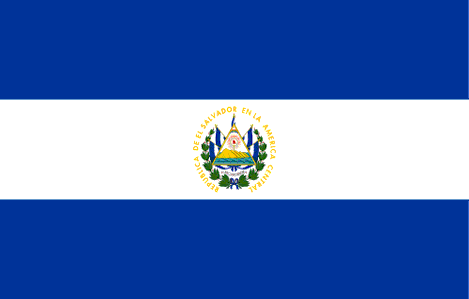
The flag of El Salvador was inspired by the flag of the Federal Republic of Central America, and by the flag of Argentina, the country that sent one of the first fleets to help consummate the independence of Central American republics from Spain.

There are two versions of the flag, one containing the national coat of arms and the other the words "DIOS UNION LIBERTAD" (Spanish: God, Union, Liberty). The one bearing the coat of arms is used by the government and state organizations. The other version is used for civil purposes. Both flags have a 3:5 aspect ratio. The actual blue and white stripes in flag are based on the importance of añil exports, añil was commonly used as a source for indigo dye.

Nicaragua

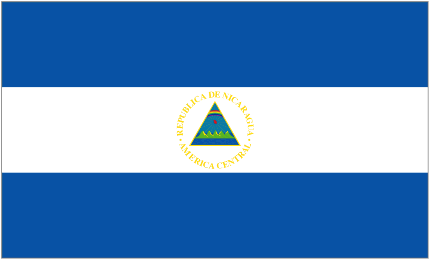
The flag of Nicaragua was officially adopted on August 27, 1971 (first adopted on September 4, 1908). It is based on the flag of the United States of Central America and inspired by the Argentine flag. The flag and the arms of Nicaragua in use today are the most similar to those used by the United Provinces of Central America. The triangle, volcanoes, rising sun, Cap of Liberty, and rainbow all appeared on the original emblem.

The coat of arms used today contains the name of the state, Republica de Nicaragua, whereas in 1823 the title was Provincias Unidas del Centro de America. The decision to revert to the emblems used by the United Provinces of Central America was taken in 1908 and reflected Nicaragua's aspirations for the rebirth of the political entity formed by the 5 nations. Except for the text around the arms, the flag is very similar to that of the United Provinces of Central America. The 5 volcanoes represent the original 5 member states, the Cap of Liberty represents national freedom, and the rays of the sun and the rainbow are symbolic of the bright future.

Costa Rica

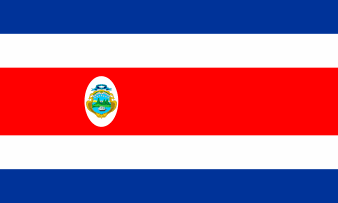
The official flag of the Republic of Costa Rica is based on a design created in 1848. The state/national flag, also used as the military ensign, includes the coat of arms of Costa Rica. The civil ensign, commonly used as an unofficial national flag, omits the coat of arms.

The flag was officially adopted on November 27, 1906, including a slight modification to the placement and design of the entrenched coat of arms. The flag was updated to reflect concurrent modifications to the national coat of arms in 1964 and 1998

Panama


The flag of Panama was made by Maria Ossa de Amador. It has been officially adopted by the "ley 48 de 1925". the flag is celebrated on November 4, one day after Panamanian independence from Colombia.

The stars and quarters are said to stand for the rival political parties, and the white for the peace in which they operate. Blue was the color of the Conservatives, and red the color of the Liberals. The Panamanian government officially described the flag in Law 15 of December 1949, as follows: The Flag of the Republic consists thus of a divided rectangle of four quarters: the upper field close to the pole white with a blue star of five points; the upper field further from the pole, red; the lower field near the pole, blue; and the lower one further from the pole, white with a red star of five points.


This flag was to reflect the political situation of the time. The blue was intended to represent the Conservative Party and the red to represent the Liberal Party. The white was intended to stand for peace and purity; the blue star stands for the purity and honesty of the life of the country; the red star represents the authority and law in the country; and together the stars stand for the new republic.